










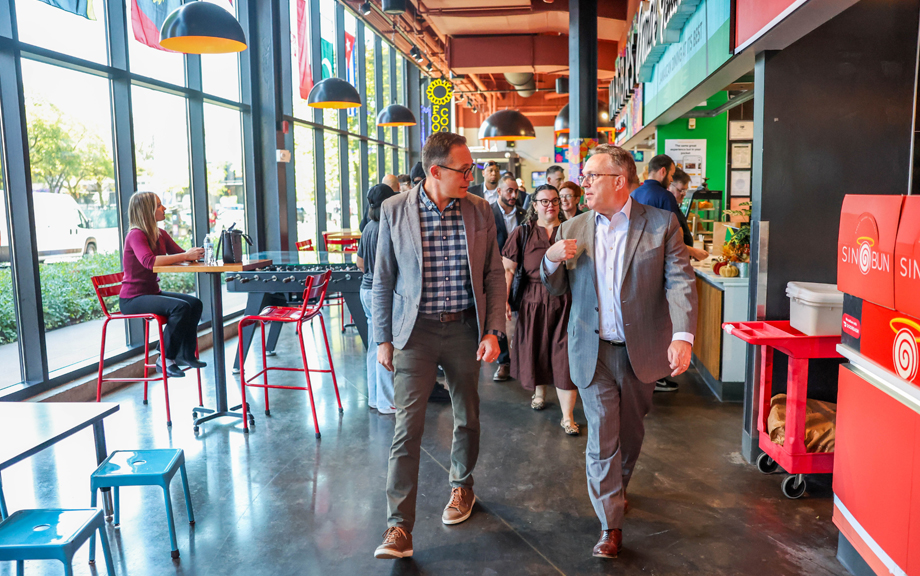
New York Fed President John C. Williams visited Rochester and Syracuse, New York, in late September to gain insights on the economy of the cities and surrounding region. The two days of meetings, roundtable discussions, and site visits with local leaders highlighted key trends shaping the future of Central New York and the Finger Lakes region.
Focusing on Business Incubation and Innovation
Both Rochester and Syracuse have made significant investments in high-tech sectors, such as advanced manufacturing, semiconductors, drones, and other unmanned aerial vehicles. While officials in Rochester emphasized the city’s strengths in these industries, they also pointed to its legacy optics, photonics, and imaging sector. The more than 150 local companies in the sector generate over $3 billion annually, according to Luminate, a Rochester business accelerator. Industry officials said their challenges include tariff uncertainty, limited availability of raw materials, and competition from large West Coast companies for workers.
In Syracuse, stakeholders credited major projects like the NY SMART I-Corridor, a regional collaboration among Syracuse, Rochester, and Buffalo, for its recent growth. The consortium of businesses, economic development groups, community-based organizations, and higher education institutions aims to grow the area’s semiconductor industry through investments from companies like Micron, which plans to invest up to $100 billion to build a semiconductor facility in Syracuse. The cities are working together to tackle challenges like limited regional mass transit and attracting smaller businesses to the semiconductor supply chain.
Both Rochester and Syracuse have business incubator hubs, which President Williams and his colleagues toured. The NextCorps hub in Rochester and the INSPYRE hub in Syracuse are focused on nurturing startups through mentorship, funding access, and coworking space. Both hubs encourage new business ventures and technological advancements.
Companies and nonprofits in the region are also working to leverage drones to assist first responders and inspect bridges, dams, reservoirs, power stations, and highways. NUAIR, a nonprofit supported by Empire State Development and New York state, is working on safely integrating drones into the national air space. Leaders of NUAIR said the organization has trained more than 4,000 state employees on the safe use of drones.
Educating and Housing the Workforce
Workforce development and housing emerged as critical challenges. In Rochester, despite a good supply of affordable subsidized housing, stakeholders noted the need for middle-market workforce housing. Officials said the city is also grappling with high construction costs and infrastructure issues, including stress on the power grid, as impediments to building much-needed new housing.
President Williams and New York Fed staff toured Syracuse’s new Science, Technology, Engineering, Arts and Mathematics High School, which offers a range of career and technical education programs and provides students with skill certificates and college credits. The school collaborates with 90 partners, including Amazon and several local businesses, to ensure students are well-equipped for future in-demand careers, stakeholders said.
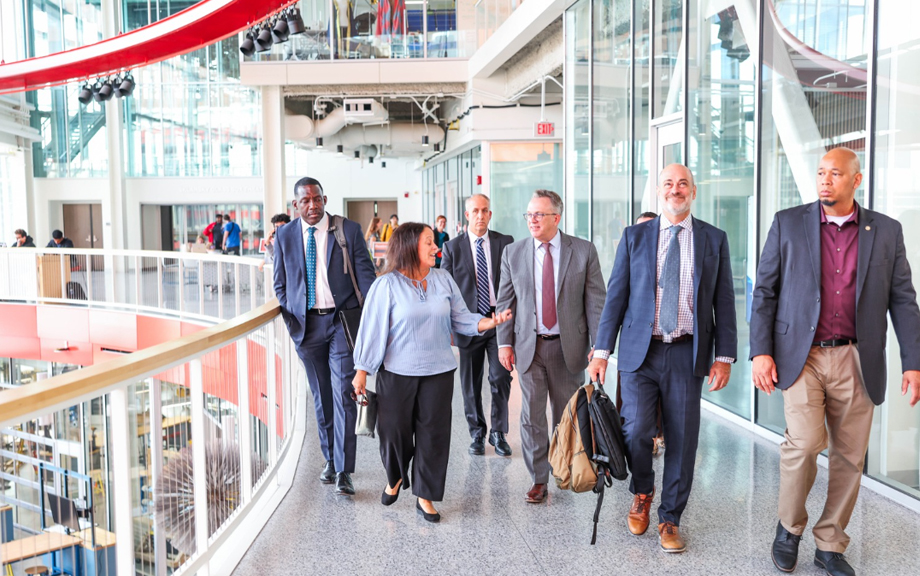
President Williams also met with faculty and students at Rochester Institute of Technology (RIT) and participated in a moderated discussion about macro and regional economic conditions. A meeting with RIT’s leadership centered on the university’s strategic focus on artificial intelligence, including plans to hire 100 new faculty members and integrate AI into the curriculum through minors, immersion programs, and advanced degrees. Stakeholders here and elsewhere noted efforts to reverse the upstate New York “brain drain” through national consortiums and partnerships.
Revitalizing City Downtowns
To meet the needs of their residents, both Rochester and Syracuse are exploring newer approaches to revitalizing their city centers.
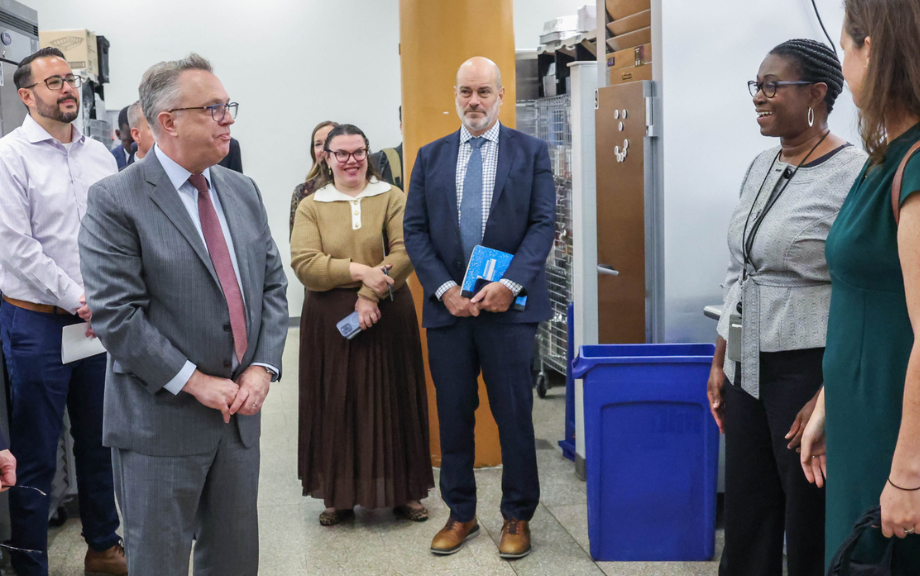
Downtown Rochester has seen a significant increase in residential developments, some of which are office conversions. President Williams and the New York Fed team toured Sibley Square, a 1.1-million-square-foot mixed-use property. In 2012, a developer bought the former department store and subsequently invested more than $125 million in renovations. The mixed-use development now has 280 apartment units, plus event, retail, and office spaces.
More broadly, officials said the downtown area still suffers from a lack of amenities, such as grocery stores and pharmacies. They also pointed to elevated vacancy rates in commercial office spaces.
Rochester has made a concerted effort to attract tourists. With tourism from Canada down nationally, Rochester launched a “Dear Canada, Love Rochester” campaign, highlighting craft beer and festivals to invite Canadian tourists back to the city. The city’s tourism outreach also emphasizes its history as a stop on the Underground Railroad, with Frederick Douglass as stationmaster.
Downtown Syracuse has seen a dramatic population increase. It’s also successfully attracted younger people; 60 percent of downtown residents are under the age of 35. However, the city still needs more affordable housing and essential amenities, according to stakeholders.
One model city leaders look to as an example of building those amenities is Salt City Market. A group of community organizers began working in the mid-2000s to create a food hall and public market for Syracuse. Built with the help of New Market Tax Credits and $25 million in foundation funding, Salt City Market is now home to 11 vendors, a grocery cooperative, and 26 apartment units. Local leaders said the market also serves as a community meeting space and social hub.
Understanding and Serving Community Needs
Entrenched poverty remains a problem in both Rochester and Syracuse.
While the poverty rate in Syracuse has gone down, it remains roughly twice the national average. The poverty rate in Rochester has also decreased, but it remains among the poorest areas in the state and nation. Approximately one-third of its population lives below the poverty line. Nonprofit leaders also highlighted barriers faced by immigrant and refugee communities, such as access to health care and other services. Cars also pose an affordability challenge, they said, with constrained credit access, high-interest loans, and high insurance costs all barriers to ownership.
Local nonprofits said their own organizations are vulnerable to government policy changes and delayed payments on contracts, with some being paid as much as a year and a half late.
Looking Ahead
The visit to Rochester and Syracuse highlighted the region’s resilience and innovation. While challenges such as housing and workforce development persist, the area’s commitment to economic growth and community development is evident. By fostering public-private and regional partnerships, investing in education, and embracing technological advancements, Rochester and Syracuse are working to be well-positioned for the future.
Shawn Phillips is the head of external engagement in the Communications and Outreach Group at the New York Fed. She is responsible for broadening and deepening relationships with civic, business, academic, and other stakeholders within the Federal Reserve’s Second District.
The views expressed in this article are those of the contributing authors and do not necessarily reflect the position of the New York Fed or the Federal Reserve System.
