









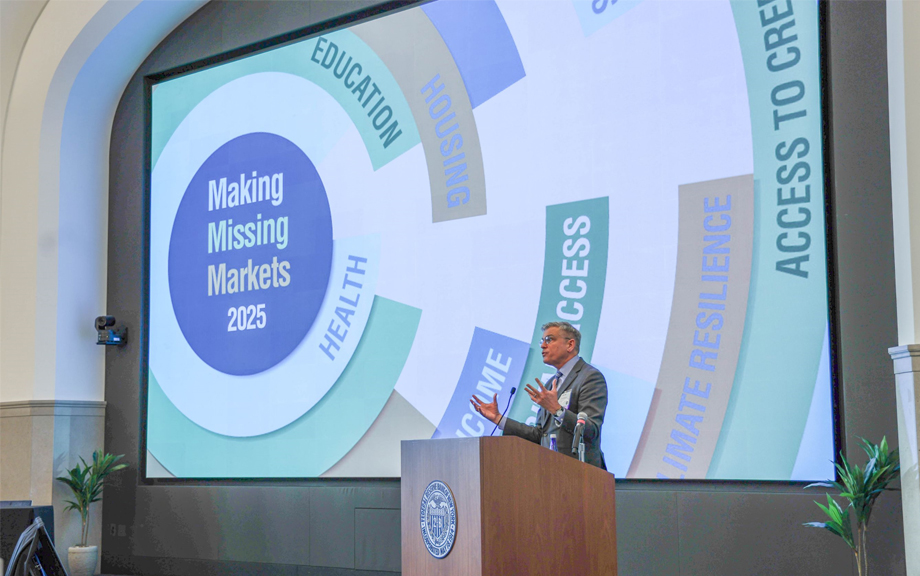
Nearly 500 entrepreneurs, community leaders, investors, and researchers participated in “Making Missing Markets: Connecting Communities and Capital,” a November event focused on fostering and improving markets channeling investments into under-resourced communities.
Community development is one of the Federal Reserve’s key functions, rooted in its mandates from Congress of maximum employment and price stability. Our Community Development team works to understand the economic experiences of lower-income households and communities to help build a stronger economy for all Americans.
As part of that effort, the team builds bridges between community development leaders and capital providers. Through its Making Missing Markets Initiative, the team brings together practitioners across diverse sectors with a shared interest in strengthening communities. The effort aims to match the strong demand in our communities for economic necessities such as skilled labor, affordable utilities, and housing with supply and innovation, New York Fed President John C. Williams said at November’s event. “Of course, everything is interconnected,” he said. “That’s exactly the goal of the Missing Markets initiative, to work through this web of overlapping supply, demand, and resources, so we can streamline solutions to build a better economy for all.”
The November event highlighted the progress made by community development leaders and design teams, which are 19 volunteer-led efforts, each of which is focused on an area for potential development. The focus areas include community broadband, rural innovation, and enterprise capital for nonprofits.
In the last year, community nonprofit leaders have also used the Making Missing Markets idea of cross-sector cooperation to tackle challenges in their own communities. These Making Missing Markets Communities in Fairfield County, Connecticut; the Adirondacks; the Syracuse area; Cincinnati, and Columbus, Ohio are new efforts aimed at coordinating community interventions and matching them with funding.
As participants discussed how these efforts can tackle community problems, the following themes emerged.
The Value of Local Leadership
Speakers from the Making Missing Markets Communities highlighted how their roles as leaders of local institutions allow them to bring together diverse stakeholders around solutions.
Dr. Carley Riley, attending physician at Cincinnati Children’s Hospital Medical Center, shared how the community efforts she leads are focused on financing and scaling services for families and communities to support youth well-being. Christina Hollenback, founding partner at Justice Capital, described how her Making Missing Markets Initiative work has brought together community partners in Syracuse to ensure residents can benefit from regional investment and economic transformation. The design team she leads has also developed a business case for community ownership of real estate, environmental infrastructure, and businesses.
The Adirondack Community Foundation is using Making Missing Markets ideas of bringing together diverse stakeholders and encouraging cross-sector cooperation to coordinate local investments in workforce housing, innovation accelerators, social safety net reconstruction, and other areas they say are “rebuilding the foundation of Small Town America.”
Fairfield County’s Community Foundation, which is leading a cross-sector effort in Connecticut, is helping CEOs of Fairfield County-based companies understand the economic opportunity inherent in community investments. They are asking business leaders to “roll up their sleeves,” said Mendi Blue Paca, president and CEO of the foundation. “While the collective solution has to be broader, it will not work if the private sector doesn’t have skin in the game,” she said.
The Need for Different Kinds of Capital
Connecting communities with capital to address their unique needs will require different types of investment, speakers said.
Dan Mendelson, CEO of Morgan Health, noted that JPMorgan Chase is using its own balance sheet to advance affordability and improve population health.
Rip Rapson, president and CEO of the Kresge Foundation, emphasized philanthropy’s flexibility to “work in capital markets in a very different way in under-invested places.” Tools like loan guarantees, grants, and investments in local capacity can mitigate risks holding back banks and other investors from deeper engagement in the community, he said.
René Jones, a member of the New York Fed’s Board of Directors and CEO and chairman of M&T Bank, pointed to M&T Bank’s ability to deploy financial capital, human capital, and social capital. This enables it to connect financial resources and ideas, bring people together, and lower barriers to broader participation in the banking sector.
Ladell Robbins, managing director and head of BlackRock Impact Opportunities, highlighted how the asset manager’s debt and equity investments help develop businesses that provide critical services communities need, like broadband connectivity.
Speakers said investors can encourage their peers to act. The Kresge Foundation is investing heavily in local funders under its belief that community foundations are the backbone of philanthropy. BlackRock’s Robbins stressed the importance of relationships, and bringing in new investors into undercapitalized places.
Innovation Makes Missing Markets
Speakers also discussed how market-making mechanisms and new asset classes have been built from the ground up. Organizations including the Connecticut Green Bank, Local Initiatives Support Corporation, and Connect Humanity are attracting investors to new types of funds for climate resilience infrastructure, community development finance, and broadband access, participants said.
New Jersey Governor Phil Murphy said innovation and a focus on the needs of working families can expand opportunity and strengthen the economy. Carol Naughton, CEO of Purpose Built Communities, called for new financing structures and “investment bankers for communities” that can help line up capital stacks.
David Erickson, head of the New York Fed’s Community Development team, said community development efforts became too siloed between the 1970s and the 1990s. “With new technology, business models, and innovations that can spot trends and break down silos, our capability to go back to the 1960s vision of ‘grab the web whole’ is really coming back into focus,” he said.
To learn more, see the event recording, or reach out to ny.fed.community.development@ny.frb.org.

Julian Macrone is a community development specialist at the New York Fed.
The views expressed in this article are those of the contributing authors and do not necessarily reflect the position of the New York Fed or the Federal Reserve System.
