











On a recent visit to New Jersey, President John C. Williams and New York Fed staff explored two dynamic urban centers—Newark and Jersey City—to understand how local leaders, businesses, and community organizations are shaping economic growth and resilience.
New Jersey is the nation’s most urban and densely populated state. Northern New Jersey, which includes Newark and Jersey City, is home to almost 70 percent of the state’s population and 75 percent of its economy. Roughly one million Northern New Jersey residents commute to New York City for work, according to New York Fed researchers. Those New York City salaries are one reason why New Jersey is among the nation’s wealthiest states by per capita income.
Themes the New York Fed team heard during the visit included housing affordability, aging infrastructure, life sciences innovation, and preparations for the upcoming FIFA World Cup.
Newark: Investment Challenges and Successes
Newark is the state’s largest city by population and one of the state’s major commercial centers. The ports of Newark and neighboring Elizabeth together are the No. 2 container port in the country, after the ports of Los Angeles and Long Beach combined. Local companies, such as Audible and Prudential, have made substantial investments in the area. Local leaders say growing sectors include tech and innovation, commercial and residential development, and film. The city’s strong arts culture also serves as an economic driver.
Still, nearly one-quarter of the city’s residents live in poverty. Newark’s population, which peaked in 1950, fell by nearly 40 percent over the second half of the 20th century, according to New York Fed researchers. While the population has rebounded noticeably, the city continues to struggle with under-investment.
Nonprofit developers say access to capital remains a problem, delaying construction of planned apartments. One developer said some projects in Newark require as many as five different sources of capital, resulting in a longer time horizon to build and higher carrying costs. A limited number of local Community Development Financial Institutions also makes capital harder to come by.
Some developers, corporations, and nonprofits told the New York Fed team about focusing their efforts on the needs of individual neighborhoods. For example, a local nonprofit said its model includes college and career readiness programs, a wellness center, and schools. A local business owner and developer said she realized some customers at her restaurant weren’t eating, but were there only to use the restaurant’s free Wi-Fi. She later incorporated up to 15 years of free Wi-Fi for tenants, as well as tutoring for students and technical assistance for seniors, in a new building she’s developing.

Jersey City: Balancing Growth and Affordability
Jersey City, home to about 3 percent of the state’s population, accounts for about 20 percent of the state’s new building permits, according to The New York Times. The city’s waterfront is less than five miles from Manhattan, and PATH train rides from the waterfront neighborhood to Lower Manhattan take less than five minutes.
Capitalizing on its location, the city has made notable progress in housing development through what officials say is a progressive planning process, streamlined approvals, and robust community outreach. These strategies have enabled the city to deliver a mix of federally supported market-rate and affordable housing, including the Bayfront Redevelopment Project. The project will eventually have up to 8,000 housing units, 80 percent of which will be reserved for low- or middle-income households.
The city’s housing development fee ordinance, passed in April, will require developers to contribute up to 1.5% of a property’s assessed value to fund affordable housing initiatives. These funds, managed through an Affordable Housing Trust Fund, will support emergency rental assistance, the rehabilitation of existing homes, and the development of new housing.
Still, local leaders say affordability remains a challenge, with housing prices driven up by rising demand from out-of-state and international buyers.
Infrastructure Challenges: A Region Under Pressure
A key challenge leaders raised throughout the visit was the mounting stress on Northern New Jersey’s infrastructure. Transportation systems are fragmented, with most commuters relying on a two-mode trip into Manhattan and operators using different payment systems. Private bus companies have terminated some lines, reducing options for residents, and overheating often causes summer train cancellations. PATH trains are packed, with commuters saying they sometimes have to wait for one or two trains to pass before finding one with standing room. Weekend traffic going into the Holland Tunnel is often gridlocked. Meanwhile, the longstanding plan to improve the 440 corridor on Jersey City’s West Side remains stalled, in part because of difficulty coordinating across agencies.
While post-Superstorm Sandy upgrades have improved power reliability and mitigated some flooding risks, low-lying neighborhoods still battle floods. Local leaders say these challenges continue to hamper regional mobility and economic growth.
Innovation and Workforce Development: Science at Work
New Jersey’s commitment to science and technology is evident in projects like Sci Tech Scity, a STEM-focused housing, office, and education development funded through state bonds. While construction costs have slowed progress, the initiative includes a high school and programs that connect students to cybersecurity careers with major employers like Bank of America. Sci Tech Scity is also piloting local programs, including an effort pairing 500 uninsured post-discharge patients with telehealth check-ins. Initial results are promising, leaders involved in the project said, with hospital re-admissions significantly lower than for patients who don’t receive the service.
During the visit, President Williams delivered a speech at the Liberty Science Center. The Science Center continues to play a vital role in STEM education, providing resources to schools lacking labs and equipment. These efforts underscore the region’s focus on preparing the next generation for fields with job growth.
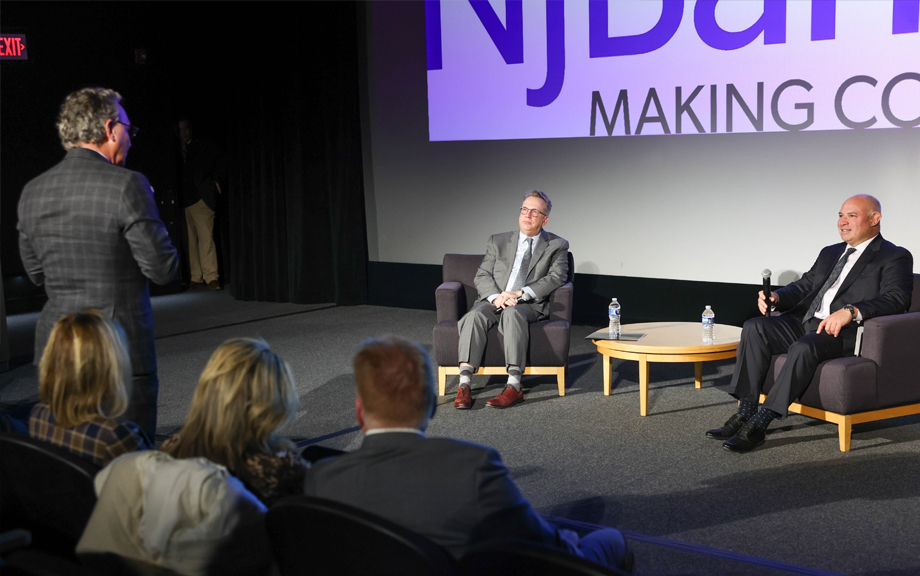
Life Sciences: A Strategic Growth Engine
New Jersey remains a powerhouse in life sciences. It is home to 5,600 life sciences companies, 180 FDA-approved manufacturing facilities, and eight of the top 10 pharmaceutical firms, according to trade groups. At a life sciences roundtable hosted by BioNJ, the life sciences trade association for New Jersey, industry leaders discussed both opportunities and headwinds: a deep talent pool and strong local educational institutions on one hand, and regulatory uncertainty and global competition on the other.
Organizations like Choose New Jersey and BioNJ are working to attract investment and support innovation through economic incentives and talent development programs. Emerging technologies, including AI-driven clinical trials, may serve to accelerate drug development and maintain the state’s competitive edge.
FIFA World Cup 2026: A Mixed Opportunity
Northern New Jersey will host the 2026 FIFA World Cup final beginning in June, with games taking place in East Rutherford, while Jersey City’s Liberty State Park hosts the tournament’s five-week-long Fan Festival. While the World Cup is expected to draw 2 million visitors to the New York-New Jersey region, local leaders acknowledge that translating this influx into broad-based economic benefits is not guaranteed. Challenges include unpredictable weather and significant logistical complexities. Efforts to involve small businesses face obstacles, raising concerns about whether local enterprises can fully capitalize on the moment.
Density, Complexity, and Promise
The area’s dense population means its housing, infrastructure, and transportation challenges are as easy to see as a jam-packed PATH train and will require deep collaboration across sectors to fix. The area’s educated workforce, extensive life-sciences industry, innovative approach to developing new housing, rich education opportunities, and strong neighborhoods show why Jersey City and Newark have long been economic drivers for the state.
Shawn Phillips is the head of external engagement in the Communications and Outreach Group at the New York Fed. She is responsible for broadening and deepening relationships with civic, business, academic, and other stakeholders within the Federal Reserve’s Second District.
Ellen Simon is a corporate communications specialist in the Communications and Outreach Group at the New York Fed.
The views expressed in this article are those of the contributing authors and do not necessarily reflect the position of the New York Fed or the Federal Reserve System.
