











The overnight U.S. Treasury repo market has experienced remarkable growth, with underlying transaction volumes for the Secured Overnight Financing Rate (SOFR) expanding from around $1 trillion in early 2022 to $3 trillion today. At the same time, this essential component of the financial system has become increasingly complex, with new segments introduced as market participants adopt central clearing. This article discusses a simplified framework to understand the complex mechanics and flows of the evolving market. This concept, referred to as the Client Segments Framework, helps the Open Market Trading Desk at the New York Fed (the Desk) monitor the repo market, an important market for the transmission of monetary policy, and report conditions to key stakeholders.
Background
The repo market facilitates liquidity and maturity transformation in U.S. dollar funding markets while serving as a key channel through which the Fed implements monetary policy. A repo is similar to a secured loan: one party sells securities to a counterparty subject to an agreement to repurchase the securities at a later date. While this basic concept appears straightforward, the actual plumbing of the market involves various settlement mechanisms and diverse participant types that can obscure the underlying dynamics.
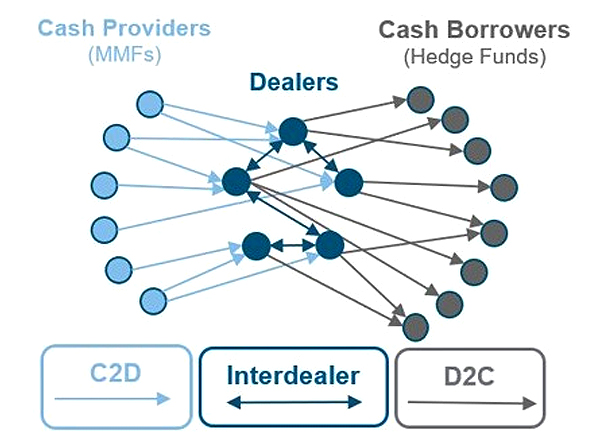
The Client Segments Framework uses the direction of movement of cash to illustrate the roles market participants play while also emphasizing the centrality of dealers as key intermediaries in the market. The term “client” is from the perspective of the dealer, which faces counterparties that cannot face each other, such as money market funds and hedge funds. These relationships are easily shown through methods of network analysis, as seen in Figure 1. The diagram reveals that the repo market is structured as a hub-and-spoke network with dealers acting as hubs, highlighting the market’s heavy reliance on dealers as intermediaries. Given this structure, the repo market can be categorized into three distinct segments: Client-to-Dealer (C2D), Interdealer, and Dealer-to-Client (D2C).
Figure 1: Stylized Treasury Repo Market Network
Source: New York Fed
The Framework
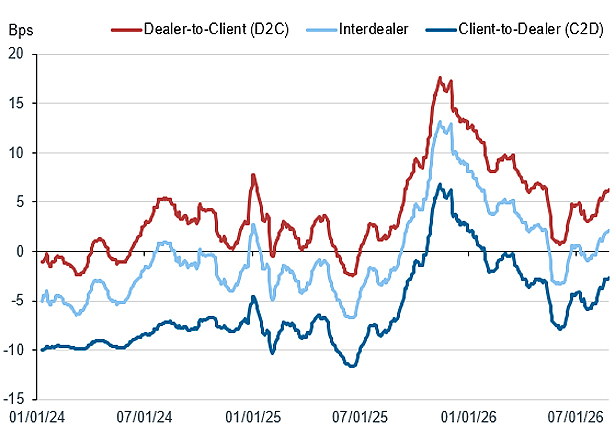
The Client-to-Dealer (C2D) segment captures dealers borrowing cash from their clients, most of which are money market funds (MMFs), and represents the key source of cash supply for the market. Because these lenders prioritize safety and liquidity, dealers with strong credit ratings dominate the borrowing side. For this reason, rates in this segment tend to be relatively low compared with the rest of the market and gravitate near the Tri-Party General Collateral Rate (TGCR). The activity in this segment is typically conducted within tri-party platforms and the Fixed Income Clearing Corporation’s (FICC’s) client clearing services.
The Interdealer segment captures the redistribution of liquidity within the dealer community and serves as a primary source of funding for lower-rated dealers that cannot transact with MMFs. Higher-rated dealers, such as Primary Dealers, also use this segment to meet unexpected funding needs. For these reasons, Interdealer rates can experience more intraday volatility compared with the other segments and are consistently above C2D rates. This is the smallest segment of the three and entirely centrally cleared by FICC.
The Dealer-to-Client (D2C) segment represents dealers lending cash to levered accounts, most of which are hedge funds executing Treasury relative-value strategies. Due to the elevated risk profile of hedge funds, the cost of funding in this segment is the highest among the three, with market participants often citing the 75th percentile of SOFR as a proxy for the transacted rate in D2C. To fund this lending, dealers borrow in the other two segments, earning an intermediation spread. This segment includes repo activity within the non-centrally cleared bilateral market1 and FICC’s client clearing offerings.2
Figure 2: Client Segment Volume-Weighted Median Rates
Calculated as a 20-day moving average spread to IORB
Applications
Through the Client Segments Framework, the Desk can more effectively communicate market developments to key stakeholders and monitor monetary policy transmission. The segments provide the Desk a view into the range of repo pricing faced by different market participants.
A key application of this enhanced view is assessing the effectiveness of the Desk’s monetary policy implementation tools. For instance, when repo dynamics lead TGCR to print above the federal funds target range3, the framework allows the Desk to identify what types of market participants are transacting at the highest distribution of rates.
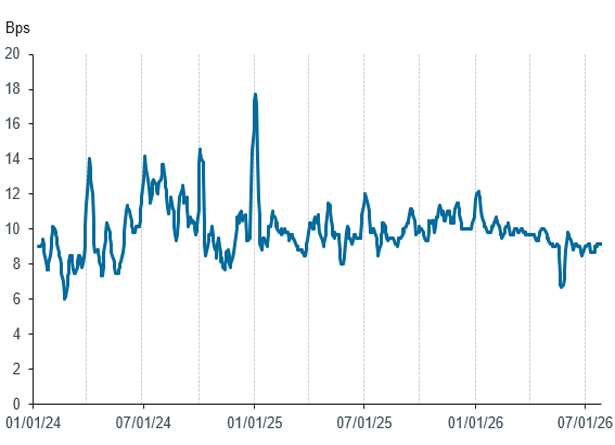
The Client Segments Framework also enhances the Desk’s market monitoring, especially when repo pricing is more volatile. Using reporting dates4 as an example, when dealers reduce their intermediation activity for balance sheet management purposes, rates rise across all segments, though at differing magnitudes, as seen in Figure 3. Consistent with other market measures, the framework reveals that the spreads between the segments, which represent intermediation spreads, widen on these dates as the cost of capital rises. This is helpful for understanding where rate pressures arise and how they could spread across the market. While market participants typically measure this spread by taking the difference between the 75th and 25th percentiles of SOFR, which is publicly available, the D2C-C2D spread provides a more reliable view as lending and borrowing can be more cleanly disaggregated.
Figure 3: Repo Intermediation Spread (D2C-C2D)
Calculated as a 5-day moving average
Source: U.S. Department of the Treasury’s Office of Financial Research (OFR), Bank of New York (BNY), Desk calculations
Resilience to Future Developments
The fundamental value of the Client Segments Framework is in viewing the repo market for what it really is—a set of different segments where distinct market participants operate—rather than looking at an aggregate view of reference rates, like SOFR, which are meant to be a broad measure. This more granular perspective allows the Desk to understand and explain the dynamics of the repo market more accurately and therefore facilitate better discourse around the effectiveness of rate control and monetary policy transmission. The framework also helps the Desk determine the efficacy of existing monetary policy implementation tools, propose adjustments to those tools if needed, and facilitate overall Desk communication around the evolving structure of this market. Looking ahead, the Client Segments Framework will be resilient to the significant changes in market structure from the U.S. Treasury repo central clearing mandate. As new products and central counterparties enter the market, this framework will become increasingly valuable for monitoring markets in a rapidly evolving landscape.
1 While the vast majority of non-centrally cleared bilateral volumes (NCCBR) are in the D2C segment, the other segments also include some minimal NCCBR volumes.
2 Figures 2 and 3 reflect overnight, same-day settled U.S. Treasury repo activity in non-centrally cleared tri-party and centrally cleared repo segments. They do not include the non-centrally cleared bilateral repo segment, for which we do not have data and under which a large portion of the Dealer-to-Client segment activity likely falls.
3 The Fed’s policy rate is the effective federal funds rate (EFFR) , but the Desk monitors broader repo rates due to their impact on the federal funds market, as Federal Home Loan Banks (FHLBs), the key lenders in the fed funds market, participate in both markets.
4 Reporting dates occur on a fiscal month-end or quarter-end when banks report on key financial and regulatory metrics and thus actively manage their balance sheet positions.
Rubi Renovato is a principal in the New York Fed’s Markets Group.
Sophia Lansell is an analyst in the New York Fed’s Markets Group.
The views expressed in this article are those of the contributing authors and do not necessarily reflect the position of the New York Fed or the Federal Reserve System.
