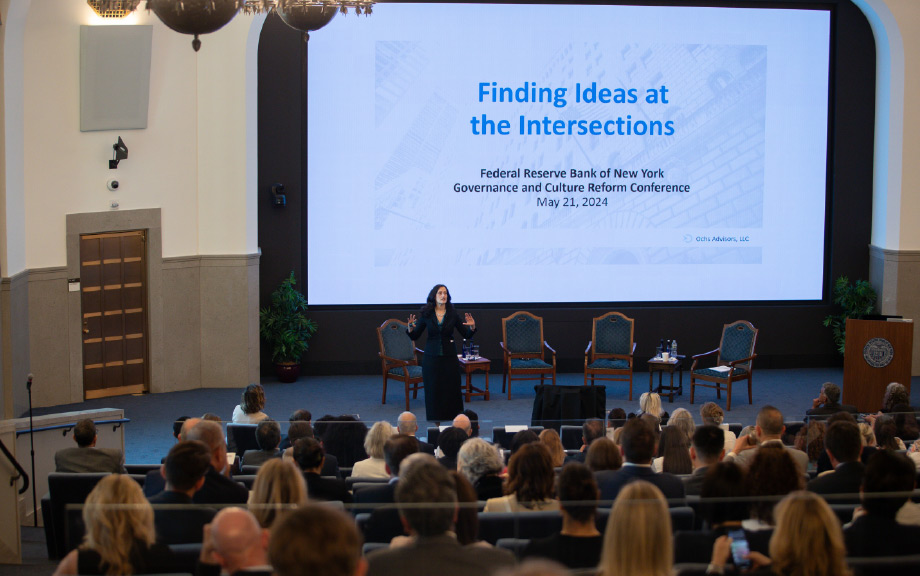
The New York Fed’s conference on culture in the financial services industry, held in May, marked the 10th anniversary of the Bank’s culture initiative.
At the New York Fed, our mission is to make the U.S. economy stronger and the financial system more stable for all segments of society. We do this by executing monetary policy, providing financial services, supervising banks and conducting research and providing expertise on issues that impact the nation and communities we serve.
Toni Dechario
The New York Fed’s conference on culture in the financial services industry, held in May, marked the 10th anniversary of the Bank’s culture initiative.
Julie Lasson
In remarks delivered at the Economic Club of New York, New York Fed President John C. Williams discussed how the Federal Reserve is working to achieve both maximum employment and price stability, the progress of getting supply and demand in better balance, and bringing inflation back down to the Federal Open Market Committee’s (FOMC’s) 2 percent longer-run goal.
Kartik B. Athreya
In this recurring column, Kartik Athreya, the New York Fed’s Director of Research, draws connections between broader economic policy issues and our everyday lives.
A type of statement one frequently hears, and that I myself sometimes make, is that “inflation is being driven by item X being stuck in a supply-chain mess,” or “item Y being suddenly in great demand,” and so on.
Jack Gutt
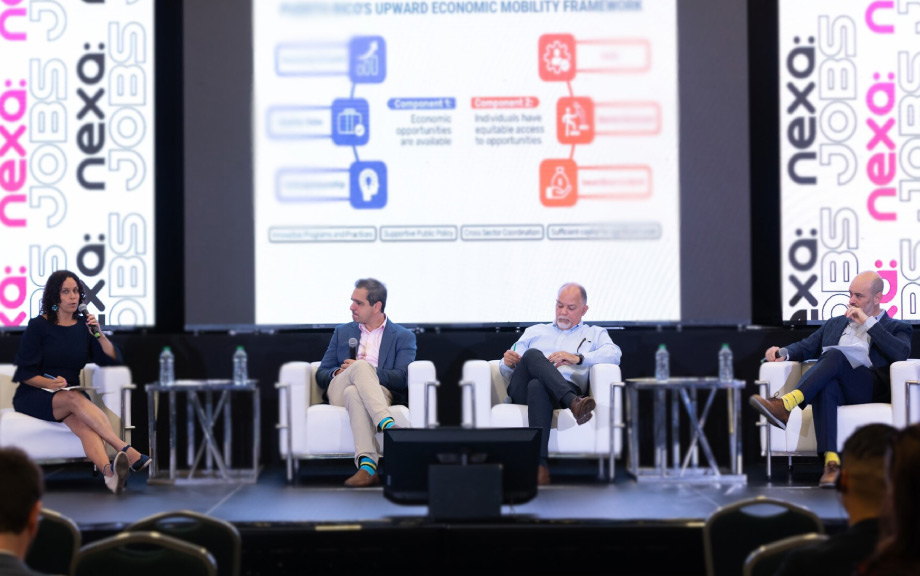
Puerto Rico is on the cusp of a once-in-a-generation opportunity to reshape its economy. That was the consensus at the NEXA Jobs Summit in San Juan, Puerto Rico on April 10-11. This gathering, organized by the Platform for Social Impact, brought together leaders from community and economic development, government, academia, and the private sector. Participants explored how Puerto Rico could take advantage of government and private funds, economic momentum following more than a decade of recession, and a young and capable workforce to develop quality jobs on the Island and address long-term poverty and economic insecurity.
Toni Dechario
The New York Fed convened its first event focused on culture in the financial services industry 10 years ago in the wake of the global financial crisis. The conference took place against a backdrop of low public trust in the industry after a series of scandals, including predatory lending, rogue trading, and rate rigging. Participants sought to understand the cultural drivers of misconduct and inspire positive change.
Graham Long
Two groups of about 10 teachers stood on opposite sides of the room, each holding a single playing card, their eyes focused on the empty space in the middle of the New York Fed’s Museum and Learning Center. The color of the card told each teacher if they were a buyer or a seller. At the signal, they sprinted into the market, calling out prices and trying to make deals.
Judy DeHaven
In remarks delivered at the Hoover Institution, New York Fed President John C. Williams discussed three key principles derived from monetary policy theory and experience that help guide central banks in achieving price stability.
Julie Lasson
In remarks delivered at the Federal Home Loan Bank of New York’s annual symposium, New York Fed President John C. Williams discussed the progress made in restoring price stability to the economy, the work still needed to return inflation to 2 percent, and the trajectory of the Fed’s balance sheet.
Kartik B. Athreya
Though I only just joined the New York Fed in February, I’ve been closely following its equitable growth research for nearly five years. Recently, I spoke with researchers from a broad range of areas across the Federal Reserve System, including micro-, macro-, and financial economics, about why “equitable” and “growth” are important to our understanding of the economy. Given today’s release of our Equitable Growth Indicators, I want to share more broadly, in my view, why this work matters to us.
Tony Davis and Javier Silva
Puerto Rico’s community development financial institution (CDFI) sector has grown 15-fold over the last decade following a collaboration that brought together leaders from government, community development finance, and Puerto Rico’s credit unions, known as cooperativas.
The Teller Window is a publication featuring expert knowledge and insight from the New York Fed, including thoughts and perspectives from senior leaders. It offers a deep look at issues that matter to the Federal Reserve’s Second District and the nation.
Articles on the Teller Window focus on the people and programs that help the New York Fed support the U.S. economy. They are written for a wide audience with the aim of illustrating what we are doing and why it matters. Stories include editorials, interviews, explainers, and reports on events and trends in our communities and region. The Teller Window is edited by the Communications and Outreach Group on behalf of the New York Fed. Separately, for analysis from New York Fed economists working at the intersection of research and policy, please see Liberty Street Economics.
The New York Fed began publishing on the Teller Window in November 2022. Articles with dates earlier than November 2022 were originally published by the New York Fed on Medium.
Step up to the Teller Window to learn more about the New York Fed’s work and views.