











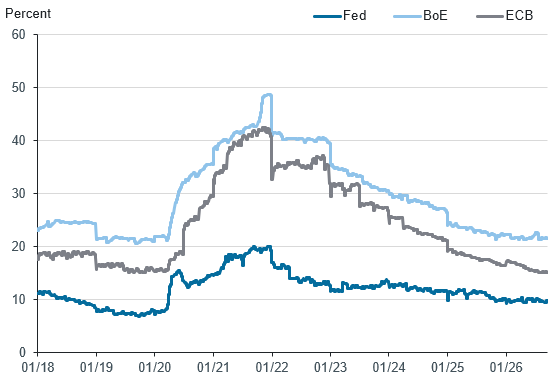
Many advanced economy central banks—including the Federal Reserve, the Bank of England (BoE), and the European Central Bank (ECB)—responded to the COVID-19 pandemic by conducting asset purchases to support functioning in sovereign bond markets and ease financial conditions. As a result of these purchases, central bank balance sheets grew to historic levels. Since then, these central banks have aimed to reduce their securities holdings and have seen the size of their balance sheets decline from COVID-era peaks (Figure 1). All three central banks have developed tools to ensure they can maintain strong rate control even as their balance sheets have been shrinking.
Figure 1: Central Bank Reserves as a Percent of GDP
There are both similarities and differences in the tools these central banks use to effectively steer short-term interest rates. This article compares current operational approaches and illustrates how these three central banks achieve effective rate control in different ways while continuing to supply the reserves that the financial system needs to operate efficiently and smoothly.
Key Policy Tools
Under all three central banks’ implementation frameworks, the central bank supplies enough reserves to the financial system such that short-term interest rates are only modestly sensitive to fluctuations in the quantity of reserves. In these frameworks, central banks choose certain administered rates to affect market interest rates and achieve rate control.
Banks hold reserve balances at the central bank that are remunerated at an administered rate. The Fed offers Interest on Reserve Balances (IORB), the BoE offers Bank Rate, and the ECB offers the Deposit Facility Rate (DFR). These administered rates determine the marginal opportunity cost for banks to hold reserves at the central bank versus lending them in the market. Because banks generally are not willing to lend at rates lower than what they can get on their deposits at the central bank, the administered rates mentioned above help set a floor for short-term market interest rates.1
Similarly, central banks also use other operations and facilities with administered rates to further support rate control. In the U.S., the Fed uses standing repo operations (SRPs) to limit upward pressure on money market rates. The BoE and ECB have overnight lending facilities that serve a similar purpose. In some contrast to the Fed’s SRP, the BoE and ECB also have repo operations that are designed to incentivize usage as part of routine bank liquidity management.
When balance sheets were large, the supply of reserves in the U.S., the UK, and the euro area was abundant, meaning that the financial system was saturated with liquidity and market rates were insensitive to small changes in the quantity of reserves. As central banks progressively shrank their balance sheets—a process still underway at the BoE and ECB—the quantity of reserves in each jurisdiction diminished. Each central bank has developed or announced tools to maintain rate control and ensure that reserves do not fall below ranges that could create undue strains in money markets.
The choices around the details of these tools can be influenced by a variety of factors, including institutional considerations that pertain to each jurisdiction, the structure of banking systems and financial markets, and policy preferences. At a high level, the Federal Reserve follows a securities-led approach to provide the marginal quantity of reserves, while the ECB and the BoE follow a repo-led approach.
Federal Reserve
The Fed provides reserves primarily through its securities holdings and supplies the marginal amount of needed reserves through Reserve Management Purchases (RMPs), which are permanent purchases of short-term Treasury securities. The Fed determines the size of its RMPs on a monthly basis, based on factors that include an assessment of reserve demand, a forecast for reserve supply, and an evaluation of money market conditions. SRPs support RMPs by offering funding to primary dealers and approved banks through daily overnight repo operations at 10 basis points above IORB.
Bank of England
The BoE lends marginal reserves through its one-week Short-Term Repo (STR) facility, which differs in purpose and function from the Fed’s SRP in some important ways. Though both provide reserves to support rate control and are backed by high-quality collateral, the STR is offered at Bank Rate, is intended to be drawn on regularly as part of banks’ liquidity management, and is offered to a wider range of counterparties.2 The BoE also administers the Operational Standing Lending Facility (OSF) to provide reserves overnight at a higher spread to Bank Rate (+15 basis points), somewhat similar to the Fed’s SRP, and can be used to manage unexpected liquidity demand.
Finally, the BoE offers the Indexed Long-Term Repo (ILTR) facility, which provides reserves at a tenor of six months and at a positive spread to Bank Rate that varies with the collateral pledged. As the BoE’s securities holdings continue to decline, BoE officials expect the ILTR, alongside the STR, will eventually supply the majority of the stock of reserves to meet the system’s liquidity needs. BoE officials have expressed a preference to reduce the interest rate risk of the assets on its balance sheet by relying more on repo operations to provide reserves. More recently, the BoE announced it will also retain a portion of its longer-dated gilt holdings to back current and future currency in circulation.
European Central Bank
The ECB lends marginal reserves through regular one-week lending operations, called Main Refinancing Operations (MRO). These weekly operations offer reserves at the DFR plus 15 basis points. Similar to the BoE’s STR, the intended purpose and function of the MRO differs from the Fed’s SRP, given it is intended to act as a marginal instrument of liquidity provision and is offered against a broad set of collateral. Once per month, the ECB also offers a Longer-Term Refinancing Operation (LTRO) for a three-month term. Euro area banks needing central bank liquidity outside of these operations can utilize the Marginal Lending Facility (MLF), receiving overnight liquidity against collateral at a rate above the MRO or LTRO rates—also sharing some similarities with the SRP and OSF.
As its securities portfolio continues to shrink and reserves continue to decline toward steady-state levels, the ECB has communicated it will also introduce two new structural operations: a structural refinancing operation, potentially for longer tenors than are currently offered, and securities purchases that will form a structural securities portfolio. The structural operations are meant to complement the current lending operations and will eventually cover the structural liquidity needs of the euro area banking system, but won’t be used to steer the monetary policy stance.
Operational Details Evolve
To maintain effective rate control, all central banks continue to refine their tools over time as market conditions evolve.
For example, the Fed introduced a second daily SRP operation in 2025 settled earlier in the morning, eliminated the aggregate operation limit, and underscored that SRP effectiveness relies on market participants availing themselves of the operations when economically sensible. Other potential changes to SRP operations, such as the option to centrally clear them, also have been discussed by the FOMC.
The BoE announced changes to the parameters of the ILTR in 2025—including increasing the auction limits—to ensure availability of an appropriate amount of reserves during the transition to its new operating framework. Take-up at the BoE’s repo facilities has steadily increased as reserve levels have been declining. The ECB has not yet introduced structural operations but plans to review the operating framework’s key parameters this year.
Both the BoE and ECB are continuing to unwind their balance sheets, and as a result are still currently providing a meaningful amount of reserves through their securities portfolios. Both are evolving their operational tools to facilitate providing a larger share of reserves through term repo lending.
All Systems Have Functioned Effectively
The experiences of these central banks demonstrate that successful monetary policy implementation can be achieved through multiple paths. All three institutions maintain rate control through administered rates, but the specific tools and operational approaches vary. Overall, overnight unsecured benchmark rates in each jurisdiction remain well anchored near each central bank’s policy target.3
1 In some cases the floor set by reserve remuneration rates may not be a firm floor. In the case of the Fed, there are some institutions that have access to the federal funds market but not to IORB. For this reason, the Fed developed the Overnight Reverse Repo Facility (ON RRP), which placed a firmer floor on money market rates.
2 The BoE estimates that the average all-in cost of the STR is 5 to 10 basis points above Bank Rate, due to collateral haircuts that are higher than market-based haircuts, on average. See Victoria Saporta, “Learning by doing,” speech at Bank of Finland & SUERF Conference, Helsinki, June 11, 2025.
3 Overnight unsecured benchmark rates in each jurisdiction: the Effective Fed Funds Rate in the U.S., the Sterling Overnight Index Average in the UK, and the Euro Short-Term Rate in the euro area.
Will Burchell is a principal in the New York Fed’s Markets Group.
Cullen Kavoussi is a principal in the New York Fed’s Markets Group.
Brian Gowen is a principal in the New York Fed’s Markets Group.
Brandon Lauer is an associate in the New York Fed’s Markets Group.
The views expressed in this article are those of the contributing authors and do not necessarily reflect the position of the New York Fed or the Federal Reserve System.
